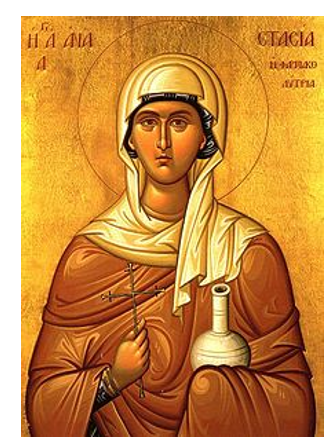
All-Merciful or just Merciful. The doctor who offered his services to the sick without money. That is why he is also called “Anargyros”. He lived in the time of Diocletian. He studied medicine under the famous physician of the time, Euphrosynos. He always visited his poor patients and offered them his medical knowledge and bread to those with nothing to eat. He still provided his good word and the teaching of the words of the Lord thus saving the souls of many sick people. He is said to have healed a blind man who became a Christian. But the authorities caught both the former blind man and Agios. They killed the healed man, so that there would be no testimony and tortured the Saint. Because Panteleimon did not deny his faith, he was finally beheaded. The Saint is shown always holding an open box, inside which medical and surgical instruments can be seen. Blind, lame, and deformed, all are protected and healed by Saint Panteleimon. The Saint appears, however, as truly merciful, because he has mercy on those who need him. In addition to healing and spiritual salvation, he offered bread to those with nothing to eat. He is therefore also presented as a patron of breadmakers. The Saint gave food to those who needed it and could not fail to provide food for the babies as well… In Kastanies, all the women who did not “put down milk”, went to the hidden sanctification of the Saint (apparently it was in a cave). Three stalactites hung there. The women burned incense in the name of the Saint and drank from the drops that dripped… This is how they “put down” milk for their babies (celebrates July 27).
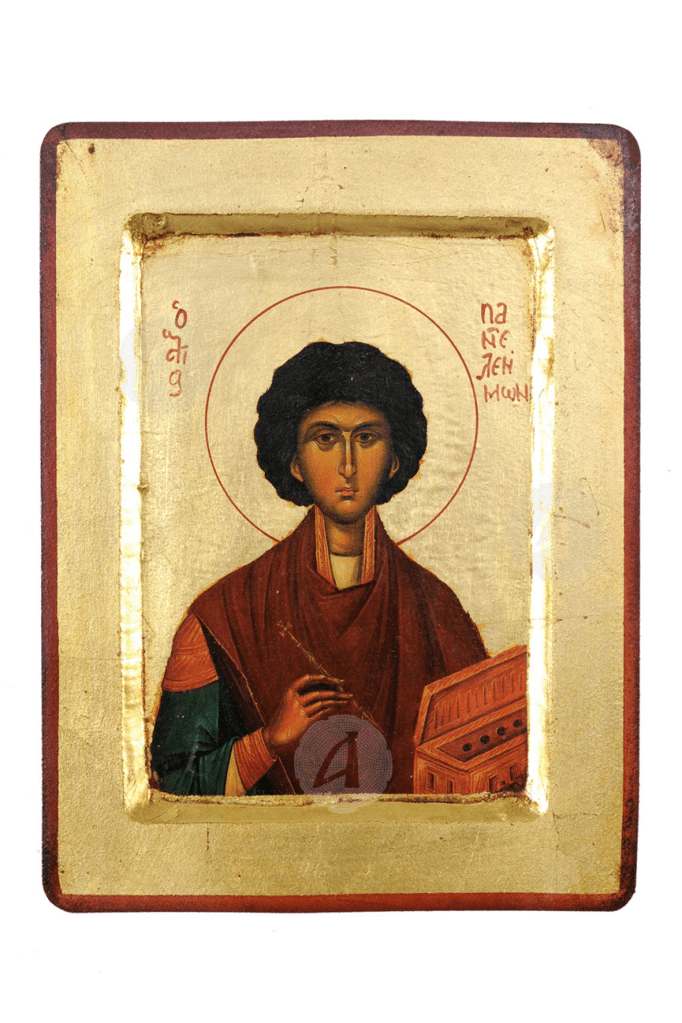
Icon of Saint Panteleimon by (athonian.gr)
Damianos and Cosmas the Romans. (The first couple, Celebrates on July 1st). They were brothers, well known in Rome where they were born, admired, and martyred in 284 AD. They selflessly offered their medical advice to the poor and the rich. First of all the doctors, their teachers, hated them for their healing and miraculous work, and then the rest of the doctors of the guild followed in envy. Eventually, they were murdered by their fellow craftsmen.
Damianos and Kosmas the Asians. (The second couple, celebrates November 1st). These holy doctors came from Asia and are simply named after the first two. Their parents were very good Christians and taught them love for God and man. The two brothers studied medicine and offered their services free of charge to patients, without distinction. But they did not cease to teach the word of God, thus healing the souls of their patients. These Saints, Anargyri, slept peacefully and were buried at Therema.
Cyrus and John. They celebrate on January 31st. The Saints worked in Asia and were martyred in the year 292 AD, during the reign of Diocletian. Initially, Kyros was a doctor. But next to him stood the other enlightened healer, Ioannis. Together they practiced, together they healed and together they worked miracles for those who approached their hermitage with faith and asked for their help.
Luke, the physician Apostle, is the author of the third Gospel, “According to Luke” and the “Acts of the Apostles”. He became a Christian in the times after Christ, through the word of Paul. He was an excellent painter, but he is also mentioned as an excellent physician. He died in Thebes of Boeotia (he celebrates September 10).
Zenobius, the wealthy physician from Cilicia. Saint Zenovius studied medicine, healed, and worked miracles in his area. He was the heir to a large fortune, but this did not prevent him from distributing it to the poor. The holy physician healed without money. He was beheaded together with his sister Zenovia by the prefect Lysias (he celebrates October 30).
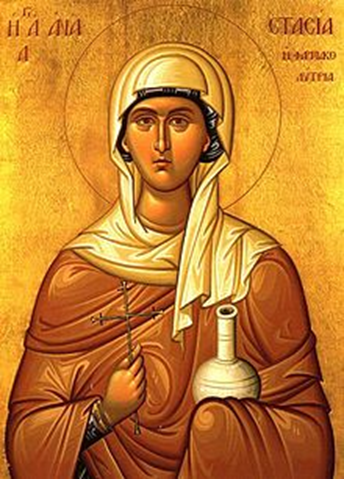
Anastasia the pharmacist (Orthodox Icon above), protects pharmacists. Agia was the daughter of a rich Roman patrician. She was beautiful, intelligent, and morally impeccable. At an early age, she married a fanatical pagan, Popplion or Pupius, who mortally hated Christians. But Anastasia was a philanthropist, that’s why she secretly went out dressed in poor clothes and visited sick people in need in their homes and prisons. He brought them medicines (pharmacolytria) and food. Through this charity work, she got to know and especially sympathized with the Christians, who were under persecution. She embraced the word of the Lord and was secretly baptized a Christian. But this could not be hidden from her cunning husband, who understood everything. So he threatened Anastasia that if she didn’t stop her night outs, and her charity work and if she didn’t renounce her faith, he would hand her over to the authorities. Agia answered him that she expects everything from him. Her husband, angry and insulted, handed his wife over to Diocletian who imprisoned her, exiled her, and then executed her by torture. Our people say that the Saint erases medicines and drives away the sorrows of life (celebrates December 22).
Varvara, for infectious diseases. Agia is one of the most beloved of the faithful. He lived during the reign of Maximian (3rd – 4th century AD). Her parents were very rich. Her father Dioskouros was a high priest of the idols in Heliopolis. Varvara was beautiful, intelligent, and very restrained in everything. in this, she had helped a Christian woman of her environment and had indoctrinated her in the new faith. Barbara’s piety and modesty attracted the attention of many. Her father understood that his daughter is a Christian and she did not deny it. So he locked her in a roof until she came to her senses. The Saint asked that three windows be opened for her in her bath, as a symbol of the Holy Trinity. Agia finally found a way and left. Her father chased her into the woods and caves where she hid. He found her, delivered her captive to the local ruler Marciano. He at first, dazzled by Barbara’s beauty, ordered her various things to renounce her faith. in the face of her refusal, he began to frighten her and then proceeded to torture her. The Saint, however, was steadfast in her faith. Marciano, to shame her, wanted to strip the Saint in front of the torturers and the crowd watching the torture. But a miracle happened before everyone’s astonished eyes. When they tore off her clothes, more beautiful and luxurious ones appeared underneath. By God’s grace, no one was allowed to see the Saint naked. Terrified, Marciano finally ordered the beheading of the Virgin Barbara. According to another tradition, Barbara, to avoid an unwanted marriage, begged God to make her ugly and was covered with smallpox rashes. This has given her the position of healer of infectious diseases especially smallpox. Associated with her name are the Hospital of Infectious Diseases and a thermal spring named after her, effective in gastric, rheumatic, and skin diseases, between Tryfos and Drymos Vonitsa. It is thought to protect children from smallpox. This terrible disease caused deep scars on the children’s faces. (celebrates December 4).
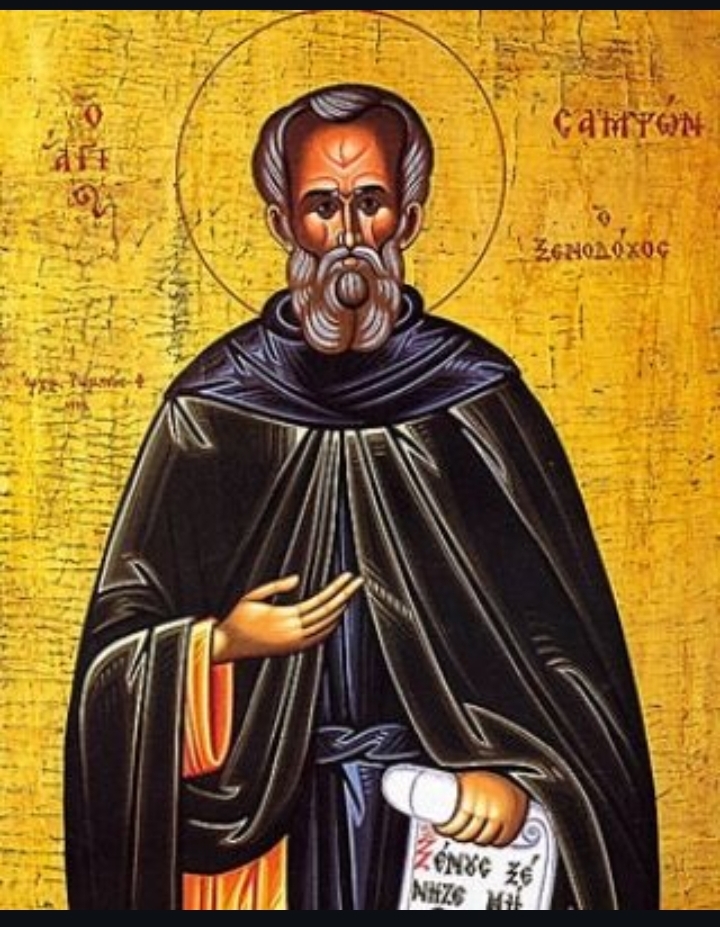
Orthodox Icon of Samson the Innkeeper.
In addition to these, the Orthodox Church honors several doctors as saints, with the main ones being the Anargyros saints, i.e. doctors who treated their patients without silver (money). In the choir of the saints Anargyri are the holy doctors: Cosmas, Damianus, Leontios, Anthimos and Euprepius the Arabs (October 17, one day before the feast of Saint Luke), Hermolaos (July 26), Samson the Innkeeper, one of his fathers institution of hospitals (June 27), Diomedes (August 16), Thallealos (May 20), Mokios (May 11), Cyrus and John (January 31), Photios and Aniketos (August 12), the modern saint Anargyros Luke the Physician, archbishop of Simferoupolis and Crimea and professor at the University of Tashkent († 1961, June 11), as well as the holy female physicians Zenaida & Philonilla (October 11), Hermione (September 4) and Sophia the Physician (May 22).
Our Orthodox Church every day of the year honors the memory of one or more Saints. He considers the Saints great personalities, who excelled in virtue, in struggles for the faith, in distinction. “Star star differs in glory,” declares the word of God. The old Paisios used to say, “…our Orthodoxy as Greeks we owe to Christ and the Holy Martyrs and Fathers of our Church…”.
For the faithful, the Saints are the signposts and the bright Stars that show the deification, the sky, and who all taught them the word of God and testified for their faith in the Triune God, the God of Love. They guarded the treasures of our race, secured the sanctuaries and the faithful of our race, and fought for the necessary supplies that our Church gives, love, kindness, and peace of our souls.

The Three Holy Doctors, Zenaida, Filonilla, and Hermione
Medical science was served by all three Saints Anargyres, Zenaida, Filonilla, and Hermione. Zenaida and Filonilla were sisters and came from Tarsus in Cilicia, it is said that they had some kinship with the Apostle Paul. Their parents were rich and well-to-do at that time, so they studied medicine and then did charity work for free. They were close to each sick person and his family and at the same time taught the word of God. Many unbelievers came to them and became Christians.
In many cases, they followed the path of the Apostle Paul. They arrived in Ancient Demetriada, in the present-day city of Volos, and lived in a cave. From this position, they healed the sick and taught the word of God. One day they leave Volos and go to Paphos, they find a big cave again, at Kissonergapou, which is one of the largest communities in the district of Paphos.
There they settled and started treating patients mainly women. The sufferings, hardships, and bad conditions inside the cave tired the Saints. First Zenaida and then Filonilla surrendered their souls to Christ. The faithful of the area buried the sisters in Kissonerga and later built a temple in their memory at that place. The Saints, Zenaida, and Filonilla celebrate every year on October 11 and are considered healers of many patients, but mainly of women.
In 1970 the then Metropolitan of Dimitrias Ilias established the feast of the two Saints and under Blessed Archbishop Christodoulou the Saints are honored together with the Saints who practiced and were martyred in the area of the Holy Metropolis of Dimitrias.
Doctors were also Saint Antipas (the one mentioned in Revelation 2, April 13 – 11), Saint Zenovius (October 30), Saint Blasius (February 11), Basil the Great (January 1), who in his institutions treated and the lepers (an unprecedented thing for the ancient world), his brother Saint Gregory, bishop of Nyssa (January 10), as shown by his work “On the Creation of Man” and others, e.g. his so-called first rule, where he takes detailed analogies of medicine and reduces them to the treatment of spiritual and moral diseases, and others.
Discover more from αlεthεια
Subscribe to get the latest posts sent to your email.


Leave a comment