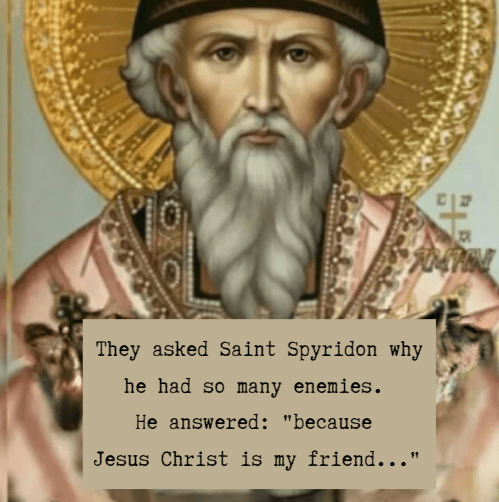
This life is a test, which is the ticket to the other, real life. This life is just a dream.
A dream, which nevertheless has been given to us to make proper use of ¬which is the confession of our Orthodox Christian faith of the only true Living God and the only Friend that man has – Jesus Christ.
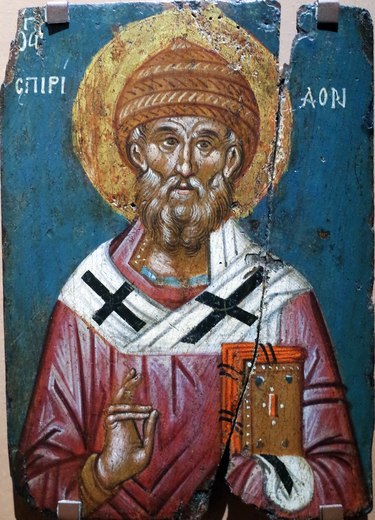
Saint Spyridon , Patron Saint of the Corfu Ionian island
Saint Spyridon was born in 270 AD in the now-occupied village of Assia (Askia) in Cyprus (and not in Trimythous – today’s Tremetousia – as many write) to a family of shepherds, who were somewhat affluent. Although he was well educated, he did not change his profession. He continued to be a shepherd as well.
As a character, the Saint was simple, kind, and full of love for his neighbor. On Sundays and holidays, he often took the shepherds and led them to the holy temples, and then explained the gospel or apostolic passage to them. God blessed him to often become the protector of widows and orphans.
He married a pious wife and had a daughter, Irene. Soon, however, his wife died. In order to heal his wound, Spyridon devoted himself even more to the teaching of the divine word.
After much pressure, he was ordained a priest. And indeed, he was a true priest of the Gospel, as Uncle Paul wants him to be: “Reproachable, sober, wise, decent, hospitable, instructive, children who have been in all modesty” (1 Timothy iii 2-7). That is, unyielding, attentive, temperate, modest, hospitable, didactic, and to have children who submit with all modesty. So Spyridon, so correct was he as a priest that when the diocese of Trimythous in Cyprus became vacant, by acclamation the people and clergy elected him bishop.
From this position, Spyridon advanced so far in virtue that God made him worthy to perform many miracles.
It should be noted here that Saint Spyridon, with the prestige of his holy and moral life at the First Ecumenical Council, which took place in Nicaea, Bithynia (Asia Minor) and in which he participated, defeated the Arians and emerged as one of the brilliant defenders of the Orthodox faith. In fact, according to tradition, after speaking for a while, he then made the sign of the Cross and with his left hand, holding a tile, in the form of the Holy Trinity, he said: “In the name of the Father” and made fire appear upwards from the tile, through which it had been baked. And when he said, “And of the Son,” water flowed down, through which the soil of the tile was kneaded. And when he added, “And of the Holy Spirit,” he showed in his handful only the soil that remained.
Saint Spyridon died on December 12, 350 AD.
Miracles of Saint Spyridon
1.One day, a poor man with a large family knocked on the door of the Diocese of St. Spyridon. He approached the saint and with tears asked him for a loan. He wanted it to pay a debt to a wealthy man who threatened to sell him his house. But where could the saint find such a large sum?
In pain caused by the bitter tears of the poor man, who was broken by grief, the loving bishop began to pace. Suddenly there in front of him, caught his eye a snake crawling through the greenery. Like lightning passed through his mind the staff of Aaron, who in Pharaoh’s palace let it fall to earth and became a serpent.
“Let it be, O Lord, that this serpent should become gold for this poor family man,” he said softly. Yes, Lord. Let it become gold, to help this unhappy creature of yours,” he said again and raised his hand. The snake stopped. And the saint bent down and took it. In his hand, the loathsome reptile was transformed and now shined golden. The poor man, full of joy, took the gold and ran and pledged it to the rich lender.
When he later paid his debt with God’s help, the creditor returned the gold pledge. And the poor man took it and with tears of gratitude returned it to the saint. He, having received it in his hands, turned his eyes to heaven, praised God for his infinite charity, and then threw it to earth. And oh of wonder! The gold became a serpent again and fled before them.
2. During the Greco-Italian War of 1940 AD, Corfu was under daily air attacks by Italian aviators for a year, but the damage was minimal. During these raids, which did not stop even at Christmas, something very strange happened. Although Italian planes usually flew very low, since Corfu did not have anti-aircraft defenses, their bombs were usually not dropped into the city, but away into the sea. As if some hand was pushing them there. And when once in a bombing a bomb fell on the women’s loft of the saint’s church, which it should be noted was full of women and children, the bomb did not explode. Its trigger mechanism did not work. The saint did not allow it. Who can in this and other similar cases remain silent and not exclaim: “Glorified be thy Most Holy Name forever, sweet Jesus.”
3. Around 1629-30 AD a new ordeal struck the blessed island of Corfu. A contagious and deadly disease, he struck it this time without distinction and mercy. It was the plague. Men and women, young and old, rich and poor, are affected daily by the disease and die both in the city, in the countryside, and in the villages. The administration of the island with the first cases rushes to vote and allocate a huge amount to limit the spread of the disease. But he is fighting unfairly. In a short time, beautiful Corfu is deserted. Shops both in the city and in major centers have closed. The market was deadened. The streets are empty. Only a few horse-drawn carts move occasionally loaded with corpses to carry their macabre cargo out of town for burial in mass graves. A tragic picture presents the whole island.
One day, in this cosmogonic calamity, the faithful and suffering people, despite the doctors’ recommendations to avoid overcrowding, dare and hasten to flood the holy temple of the saint and with heartbreak and hot tears to seek their intercession.
And salvation is not long in coming. It is offered quickly and richly.
The historian of Corfu Andreas Marmoras who lived at the time, he tells us that the terrible epidemic, despite the lack of relevant medicines, was soon reduced to a minimum and by Palm Sunday it had completely stopped. All the nights when the city was afflicted by disease, over the temple of the saint there seemed something like the light of an otherworldly lamp. It was the sign that the saint was watching over and guarding his people. This is how the faithful explained it. The light was constantly seen by the night purposes of the fortresses.
This terrible epidemic, the plague, occurred a second time in Corfu after about forty years, in 1673 A.D. And this time the disease spread quickly to towns and villages. There have been many cases. The scythe of death was harvested again this time daily by a large number of the inhabitants.
At the entreaties of his people, the miraculous saint hastened to ascend again to the throne of Divine Majesty, the contrition and tears of the faithful people along with his own, and to seek and receive speedily their heavenly mercy and salvation. The words of God’s Spirit, “call upon me in your day of sorrow, and we exalt you and glorify me” (Psalm 15) found their full application in this case as well. To the supplications of the divine prelate and the repentant people, the answer was not long in coming. Day by day cases decreased to a minimum and in the last days of October they stopped abruptly. And this time at the top of the bell tower for three nights the faithful saw a steady light, and in this otherworldly light, the miraculous saint hovering and with a cross in hand pursuing a pitch-black ghost, the disease, who was trying to avoid the saint and be saved.
The gratitude and thanks of the faithful people were once again great. With the decree of the Venetian administration, it was established since then that every first Sunday of November there should be a solemn and popular procession of the holy Tabernacle so that the people and especially the new generation remember their true and vigilant protector and Savior.
Discover more from αlεthεια
Subscribe to get the latest posts sent to your email.


Leave a comment