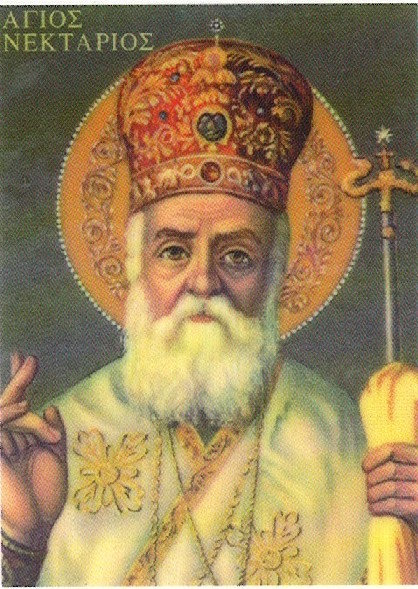
St. Nectarios (1846-1920), Metropolitan of Pentapolis and Wonderworker of Aegina, was officially recognized as a saint by the Ecumenical Patriarchate of Constantinople in 1961. His feast day is celebrated on November 9. He is often referred to as Nectarios of Pentapolis or Nectarios of Aegina, and his name is sometimes spelled Nektarios.
St. Nectarios was born on October 1, 1846, in Selymbria in Thrace to a poor family. His given name was Anastasios Cephalas. At the age of 14 he moved to Constantinople (Istanbul) to work and further his education. In 1866 he left for the island of Chios to take a teaching post. He then became a monk at the age of thirty.
Three years after becoming a monk he was ordained a deacon, taking the name Nectarios. He graduated from the University of Athens in 1885. During his years as a student at the University of Athens he wrote many books, pamphlets, and Bible commentaries.
Following his graduation he went to Alexandria, Egypt, where he was ordained a priest and served the Church of Saint Nicholas in Cairo with great distinction. In recognition of his piety and brilliance as a preacher, as well as his administrative ability, he was consecrated Bishop/Metropolitan of Pentapolis (an ancient diocese in Cyrenaica, in what is now Libya) by the Greek Orthodox Patriarch Sophronios in 1889.
He served as a bishop in Cairo for one year but was then unjustly removed from his post and was also anathematized. This was a result of lies made up by jealous clerics who envied his popularity with the people. Patriarch Sophronios refused to listen to St. Nectarios, who was sent away from Egypt without trial or explanation and was never given an opportunity to defend himself.
After his dismissal, he returned to Greece in 1891 and spent several years as a preacher (1891-1894). He was then appointed director of the Rizarios Ecclesiastical School for the education of priests in Athens, where his service was exemplary for fifteen years. He developed many courses of study and wrote numerous books, all while preaching widely throughout Athens.
In 1904 at the request of several nuns, he established a monastery for them on the island of Aegina. The monastery was named Holy Trinity Monastery. In December of 1908, at the age of 62, St. Nectarios resigned from his post as school director and withdrew to the Holy Trinity Convent on Aegina, where he lived out the rest of his life as a monk. He wrote, published, preached, and heard confessions from those who came from near and far to seek out his spiritual guidance.
While at the monastery, he also tended the gardens, carried stones, and helped with the construction of the monastery buildings that were built with his own funds. He was also the Metropolitan of the island of Aegina.
St. Nectarios died on the evening of November 8, 1920, at the age of 74, following hospitalization for prostate cancer. The commemoration date was set for the next day, November 9, because November 8 is the feast of Synaxis of Archangel Michael. The first posthumous miracle took place when the shirt of St. Nectarios was accidentally placed on the neighboring bed: a paralyzed man who was lying there was suddenly healed. The body of St. Nectarios was taken to the Holy Trinity Convent, where he was buried by the only clergyman- his best friend and spiritual brother Saint Savas the new of Kalymnos, who later painted the first icon of St. Nectarios. The funeral of St. Nectarios was attended by multitudes of people.
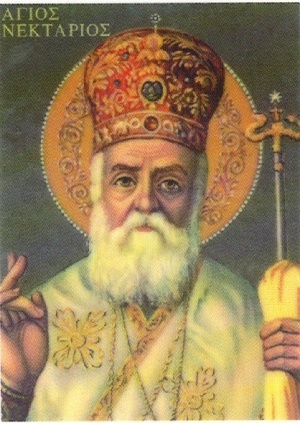
An icon of St. Nectarios of AeginaMany people regarded St. Nectarios as a saint during his lifetime because of his prayerful life, his humility, his purity and other virtues, and his writings, as well as the miracles he performed. St. Nectarios also had the gift of prescience.
Quotes
-Seek God daily. But seek Him in your heart, not outside it.
– Don’t let anything deprive you of hope.
– Happiness is found within ourselves, and blessed is the man who has understood this. Happiness is a pure heart, for such a heart becomes the throne of God
-The Merciful God wants the happiness of all of us both in this life and in the next. That is why He founded His holy church to cleanse us from sin, to sanctify and reconcile us to Him, and to grant us the blessings of heaven. The Church has its arms open to welcome us. Let those of us who have a heavy conscience run fast. Let us run and the Church is ready to bear our heavy burden, to grant us boldness towards God, to fill our hearts with happiness and bliss.
-Beware of even small offenses. If a sin happens to you inadvertently, do not despair, but get up quickly and pray to God, who has the power to lift you up.
– The soul seeks confession because it knows the Divine commandment because it has understood that it is the only means of reconciliation and reconciliation with God.
– Be vigilant and pray so as not to be tempted. Do not despair if you constantly fall into old sins. Many of them are both naturally powerful and habitual. Over time, however, and with diligence they are defeated. Nothing to despair of.
-Temptations are granted to reveal hidden passions, to fight them, and thus to heal the soul. They too are a sign of divine mercy. So leave yourself in God’s hands with confidence and ask for His help to strengthen you in your struggle. Hope in God never leads to despair.
Discover more from αlεthεια
Subscribe to get the latest posts sent to your email.


Leave a comment