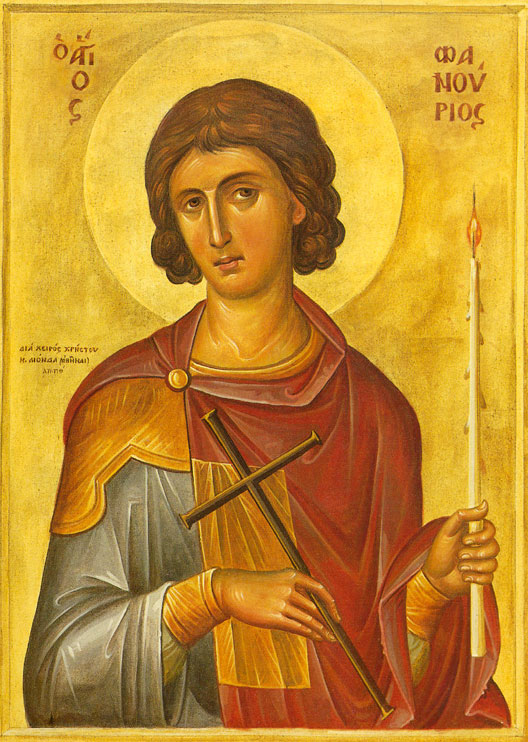
Agios Fanourios is one of the most beloved saints throughout the Greek people, who every year honor and celebrate his memory on August 27.
This beloved saint could undoubtedly be described as a gift from God because he was and remained unknown for many centuries. He became known by accidentally finding his icon in the 14th century AD in Rhodes when they were digging old houses in the southern part of the old wall. There was found an ancient temple with many destroyed icons and among them the well-preserved icon on which the then metropolitan of Rhodes Nile II Diasporinos (1355 – 1369 AD) read the name of the Saint “Saint Fano”.
In the icon, the Saint was represented as a young soldier, holding a cross in his right hand, on which there was a lit candle, and around the icon his 12 martyrs. In them the Witness was depicted: standing among soldiers and being tried by the ruler; being struck by them with stones in the mouth and head; being whipped again by them stretched out against the earth; sitting naked and scraping his body with iron claws; be locked up in prison; to be tortured before the sovereign’s step; to be burned in the parts of his body with lit candles; be tied to manganese and tortured; to be among wild beasts unharmed; lie on the ground and have his body pressed against a large stone; to be in a pagan temple carrying burning coals in his palms, and the devil escaping into the air with lamentations; standing in a furnace of fire with raised hands in the shape of supplication.
The ancient temple where the icon was found was rebuilt, after many attempts, by Nile and dedicated to the name of Saint Fanourios, who apparently also compiled his Service.
One of the many miracles of Agios Fanourios is the one narrated below. During those years, Crete was ruled by the Venetians, who did not allow the presence of an Orthodox High Priest on the island. Four men to receive the ordination traveled from Crete to Koroni in the Peloponnese and on their return, they were captured by the Agarens, who killed one and carried the other three to the Palaces (Miletus).
When their spiritual father, named Jonas, was informed of the fact, he traveled to Rhodes and there negotiated their release with lord George Petranis, who had commercial relations with the Turks of the Palaces. However, due to war unrest in the region, the effort to free them became more difficult. Jonah, according to ecclesiastical custom, visited the blessed Nile and he told him about Saint Fanourios and his miracles, urging him to invoke his perception and help for the problem that concerned him. Indeed, the spiritual man did as urged by the Metropolitan, and a few days later a message arrived from the Palaces that the developments were positive. The captive priests were miraculously released and their spiritual father Jonas, out of gratitude to the Great Martyr, returned, brought to Crete a copy of his icon, and celebrated his memory ever since.
The love and honor with which Agios Fanourios is surrounded has given rise to various beautiful and pious traditions in our people, among which is the festive custom of the “Pitta of Agios Fanourios” (a pie after the name of Saint Fanourios), or the “Fanouropita” that takes place on the eve of his feast. This pie is usually small and round like a small bread, distributed to the faithful and is sometimes made to reveal a lost object or a lost cause or even to reveal health to a patient. There is also a tradition that this pie refers to his mother.

Φανούριος φῶς πᾶσι πιστοῖς παρέχει,
Κἂν εἰς σκότος ἔκειτο τῆς γαίας μέγα.
Φανούριος φῶς πᾶσι πιστοῖς παρέχει,
Κἂν εἰς σκότος δ᾿ ἔκειτο τῆς γαίας μέγα.
Εἰκάδι ἑβδομάτῃ Φανουρίου σηκὸς γῆθεν φάνθη.
Discover more from αlεthεια
Subscribe to get the latest posts sent to your email.


Leave a comment