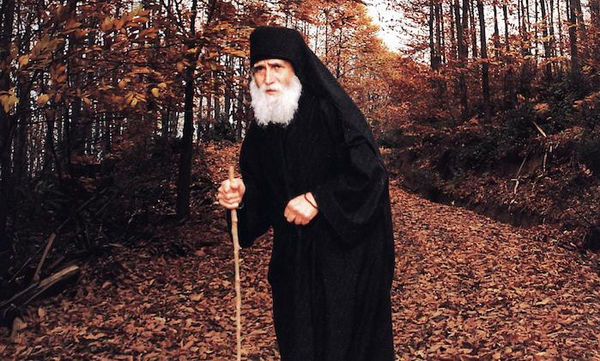
Saint Father Paisios of Mount Athos was born to pious parents, Prodromos and Evlampia Enzepides, in Farasa, Cappadocia, on July 25, 1924 AD, a few days before the Pharasians left their homeland for Greece. At his baptism, Saint Arsenios of Cappadocia (see November 10), the full-day and holiness-filled priest of the Cappadocs, named him Arsenios, “to leave him a monk at his foot”, as he characteristically said.
In Greece, the family of little Arsenios settled in Konitsa, Epirus, where he spent his childhood and youth. Brought up with the stories about the miraculous life of Saint Arsenios, he said that he would become a monk from the age of 5! And after learning to read, his favorite occupation was reading the lives of the Saints, whose ascetic struggles he imitated with fervent zeal.
After his encyclical studies, he did not want to continue school, but preferred to imitate Christ and studied the carpenter’s trade, which he practiced with diligence and skill. At the age of 15 he was worthy of the sight of the Lord for a single thoughtful thought, through which he repelled a demonic insult to the temptation of unbelief. Since then, the flame of God’s love and the longing for the monastic life have flared up even more within him.
Times of turmoil followed for Greece, due to the foreign occupation and the civil war. However, the Saint, both as a citizen and as a soldier during his service (1945 – 1949 AD), showed unparalleled courage and self-sacrifice. He was willing to give every moment and even his life for the salvation of others. Often in the midst of a barrage of deadly fire, he happened to save many soldiers with his fervent prayers and saved himself miraculously.
Because he served most of his military service as a radio operator, many publications dedicated to the life of the Saint refer to him as “God’s Radioman”. In fact, the Saint, citing as an example his specialty in the army, replied to someone who doubted the usefulness of monastic life that monks are “God’s radios”, meaning their fervent prayer and concern for the rest of humanity.
He finally followed the advice of a venerable elder and joined the brotherhood of the Holy Monastery of Esphigmenos, known at the time for its strict order. There he lived in complete obedience and indulged in excessive exercise, exaggerating labor for the sake of Christ and his brothers. Thus, on March 27, 1954 A.D. he became a monk. He received a prayer and the name Averkios.
However, having an unquenchable desire for a quiet and idle life, he received Abbot’s blessing and went to become a monk in the Holy Monastery of Filotheou, which was then in a peculiar state. There he prepared for the life of the hermit, under the guidance of a discreet and wise elder, elder Simeon. On March 12, 1956 A.D., he became a small monk and received the name “Paisios”, thanks to the Metropolitan of Caesarea Paisios II, who was also his compatriot.
. In the last years of his life, the pains from various diseases such as colitis, which left him permanently dyspeptic, inguinal hernia, and especially from cancer he had been diagnosed with, became more and more. Nevertheless, he was calm and endured without complaining at all. Instead, he continued to pray for everyone.

QUOTES
-Thoughts are like airplanes flying in the air. If you ignore them, there is no problem. If you pay attention to them you create an airport inside your head and permit them to land!
– Live simply and without thinking too much, like a child with his father. Faith without too much thinking can work wonders. The logical mind hinders the Grace of God and miracles. Practice patience without thinking too judging with a logical mind.
– what I see around me would drive me insane, if I did not know that no matter what happens, God will have the last word.
-Philotimo is the reverent distillation of goodness, the love shown by humble people, from which every trace of self is filtered out. Their heart is full of gratitude toward God and their fellow men, and out of spiritual sensitivity, they try to repay the slightest good that others do them.
– Do not believe your thoughts, neither when they tell you that you are terrible, nor when they tell you that you are a saint.
-When the housewife says the wish (the Jesus Prayer), and does the housework, everything is sanctified. And her food and those who eat her food.
– As health comes from bitter medicine, so too does the salvation of souls from bitter experiences.
– “The man who has humility is covered by the grace of God. However, the proud man is like a broken rudder which runs awry, or like a saw sharpened only on one side”.
-Desire and effort must come from you. God will provide the power and the result. Desire and effort must come from you. God will provide the power and result.
– In our time, unfortunately, reason has shaken faith and filled souls with doubts. Thus, we are bound to be deprived of miracles, because miracles are lived and not explained.
-It is no use rubbing one’s knees with countless prostrations if one does not rub one’s nose with humility (inner repentance) at the same time. The one who asks God for humility, but does not accept the man God sends to humiliate him, does not know what he is asking for, because virtues are not bought like grocer’s shopping (as many pounds as we want), but God sends us humans to be tested, to work and to be crowned. We owe more gratitude to those who wronged us and the thorns of our souls came out, than to those who would reveal to us our hidden unknown treasure.
Discover more from αlεthεια
Subscribe to get the latest posts sent to your email.


Leave a comment